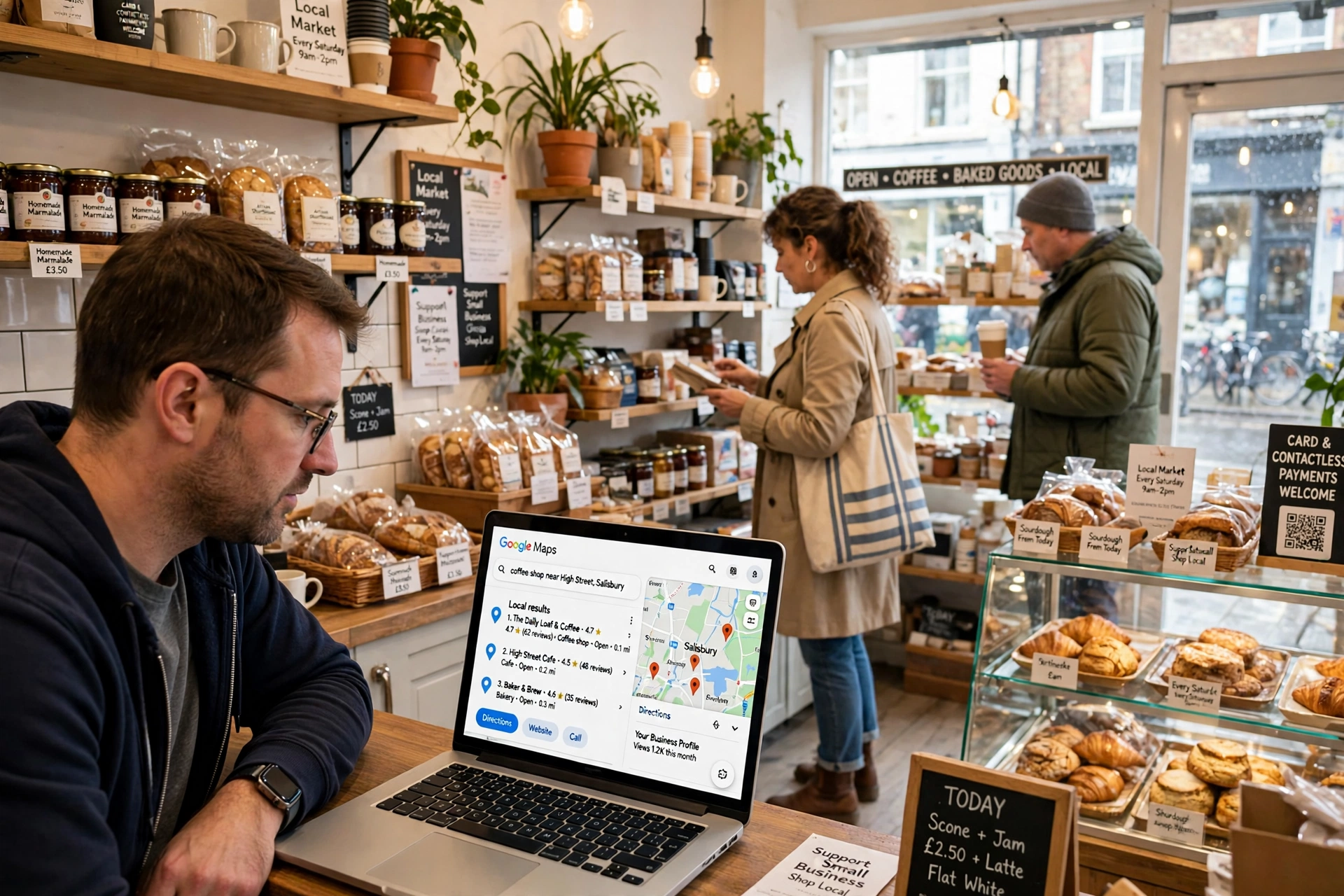
When a customer searches “plumber near me” or “best café in Bristol”, Google shows them businesses nearby — and for a small business, those searches are often the cheapest customers you will ever win. That is what local SEO for UK small businesses is about: making sure your business appears in the map results and local search results when people in your area are ready to buy. This guide works through the steps in the order that matters, from your Google Business Profile to reviews, local pages, and tracking, so you can build local visibility without wasting money on the wrong things first.
A useful fact to start with: a large share of local searches end in a visit or a call within a day, and the map results — the box with a map and three listings at the top of the page — capture a big share of clicks. That is why local SEO punches above its weight for small businesses: you are not competing with the whole internet, only with the businesses in your area, and the work is mostly free apart from your time.
How Google Decides Which Local Businesses to Show
Google says local results are mainly based on three factors: relevance, distance, and prominence. Relevance is how well your business matches the search — a café that lists “coffee shop” as its category will match coffee searches better than a business with a vague category. Distance is how close you are to the searcher, which you cannot change, but you can make sure your service area is set correctly. Prominence is how well known and trusted your business appears online: reviews, ratings, citations in directories, and mentions elsewhere all feed into it. Every step in this guide improves one of those three factors, and none of them requires paying Google for a better ranking — Google is explicit that there is no way to pay for a better local ranking.
That last point matters because it protects you from bad advice. Anyone who promises you the number one spot for a fee, or offers to sell you hundreds of directory listings overnight, is selling something Google does not reward. Local SEO rewards steady, genuine signals: a complete profile, real reviews, accurate details everywhere, and content that actually helps local customers.
Step 1: Claim and Optimise Your Google Business Profile
Your Google Business Profile is the single most important asset in local SEO, and it is free. If you have not already, claim your listing — search your business name in Google Maps, and either claim an existing listing or create one — and complete verification. Then fill in every field properly: the right primary category (and helpful secondary categories), an accurate address and service area, opening hours including holiday hours, a phone number, a website link, and a description that uses all the space available to explain what you do, who you serve, and what makes you different, with natural mentions of your town or city and services.
Add photos regularly: your shopfront, your team, your work, and your products. Businesses with photos get noticeably more direction requests and website clicks than those without, because customers trust a listing they can see. Use Google Posts for offers, events, and news — they keep your profile looking active and give customers a reason to choose you this week, not just in general. And answer the questions customers ask on your profile, because unanswered questions are answered by anyone, including competitors. For the technical side of your website, our guide on how to improve website speed in the UK covers a ranking factor that local customers notice immediately on their phones.
Step 2: Keep Your Business Details Identical Everywhere
NAP consistency — your Name, Address, and Phone number — sounds dull, but it is one of the easiest trust signals to get right and one of the easiest to break. If your website says one phone number, your Google profile another, and a directory an old address, Google has less confidence that any of them are correct. Audit your details across your website, Google Business Profile, and the main UK directories — Yell, Thomson Local, and Bing Places are the usual starting points — and fix every mismatch, including small ones like “Ltd” versus “Limited” or a flat number written differently.
While you are at it, check that your website itself is set up for local search: a clear contact page with your address and phone number, a footer with the same details on every page, and a location page if you serve several towns. If your website is new or needs a rebuild, our guide on how to choose a web design agency in the UK explains what to ask before you commit. Getting the basics right on your own site makes every other local signal stronger.
Step 3: Earn Reviews — and Reply to Every One
Reviews are the most visible part of prominence, and customers read them before they call. The best time to ask is right after a good experience: a short message with a direct link to your Google review page, sent while the customer is still happy, works far better than a generic request weeks later. Make it a habit, not a campaign — a steady flow of recent reviews beats a sudden burst, and it looks genuine because it is genuine. Never buy reviews or offer incentives for positive ones; that breaks Google’s rules and risks your profile.
Reply to every review, positive and negative. Thank happy customers by name and mention the service they used — it shows future customers you care, and it adds natural, relevant text to your profile. For negative reviews, stay calm and specific: apologise for the experience, explain what happened if you can, and invite the customer to contact you directly. A thoughtful reply to a complaint often impresses future customers more than the complaint puts them off. And do not ignore old reviews either; a reply months later still shows you are paying attention.
Step 4: Build Local Pages and Local Content
If you serve more than one town, give each main service area its own page — but make each page genuinely useful, not a copy of the same text with the town name swapped. A good local page describes the service, shows real photos of work in that area, mentions local landmarks or neighbourhoods naturally, answers the questions customers in that area actually ask, and includes a clear call to action. Google is clear about avoiding low-value duplicate content, and customers can tell the difference too: a page that could belong to any town in the country convinces nobody.
Beyond service pages, publish content that serves your local audience: guides to local regulations, seasonal advice for your area, or answers to the questions your customers keep asking in person. This is where local SEO and ordinary SEO meet — helpful content earns links and rankings of its own, and it gives you something worth sharing locally. Our guide to WordPress SEO for beginners covers the on-page basics that make those pages rank, from titles and headings to internal links between your local pages.
Step 5: Build Local Citations and Relevant Links
Citations — mentions of your business name, address, and phone number on other websites — help Google confirm you are real and established. Start with the major UK directories and your industry associations, then add local sources that make sense for your business: your local chamber of commerce, community groups, local news sites, and suppliers or partners who genuinely work with you. Quality beats quantity here; a handful of relevant, trustworthy listings is worth more than hundreds of spammy ones.
Local links work the same way. Sponsor a local event, support a community project, or share expertise with a local publication, and you will earn mentions that no competitor can copy by buying a package. These links are slow to build, but they are also hard for competitors to replicate, which is exactly why they are valuable. Keep a simple spreadsheet of where you are listed and linked, so you can spot duplicates and outdated details when you move premises or change numbers.
Step 6: Track What Is Actually Working
Local SEO without tracking is guesswork. Check three things monthly: your Google Business Profile insights (how many people found you in search versus Maps, how many called, asked for directions, or visited your website), your rankings for your main “service + town” searches, and your enquiries — calls, forms, and bookings — by source. If profile views are rising but calls are not, your profile may need better photos or a clearer description. If calls are rising from one town but not another, that town’s page may need more work. Small, regular checks beat a big annual review, because you can fix a problem in a week instead of discovering it a year later.
Be patient with timelines. Most small businesses see early movement in four to six weeks — more profile views, a few more calls — and meaningful, stable results in three to six months, depending on how competitive your area and industry are. That is normal, and it is still far cheaper than paying for every click forever. To sum up, local SEO for UK small businesses is a sequence, not a trick: a complete Google Business Profile, identical details everywhere, a steady flow of genuine reviews, useful local pages, relevant local citations, and monthly tracking. Do those six things well, and you will be the business nearby customers find first. For further reading, Google’s own local ranking guidance and the Kerbrank guide to local SEO for small businesses both set out the same order of priorities used here.
FAQ
How long does local SEO take to work for a small business?
Expect early movement in four to six weeks and meaningful, stable results in three to six months, depending on your area and industry. It is slower than paid ads but the results keep working without ongoing ad spend.
Can I pay Google for a better local ranking?
No. Google states clearly that there is no way to request or pay for a better local ranking. Paid ads appear in separate, labelled slots and do not improve your organic or map ranking.
How many reviews do I need?
There is no magic number. A steady flow of recent, genuine reviews matters more than a large total, and replying to every review matters as much as collecting them.
Do I need a separate page for every town I serve?
Only for the towns you genuinely serve and want to rank in, and only if each page is genuinely useful — real local detail, photos, and answers — rather than the same text with the town name swapped.

Google Business Profile Optimisation UK 2026: A Small Business Guide
November 5, 2026[…] profile with fifty old reviews and silence. This pairs with the wider local picture in our guide to local SEO for UK small businesses, where reviews sit alongside local pages and […]
SEO Audit Checklist for UK Small Businesses (2026)
November 7, 2026[…] rank for everything ranks for nothing. If you are unsure how to structure these pages, our guide to local SEO for UK small businesses explains the local landing page approach step by […]
Content Marketing for UK Small Businesses in 2026: A Practical Guide
November 8, 2026[…] topics, and it converts better, because the reader is already in your catchment area. Our guide to local SEO for UK small businesses explains how the two work […]