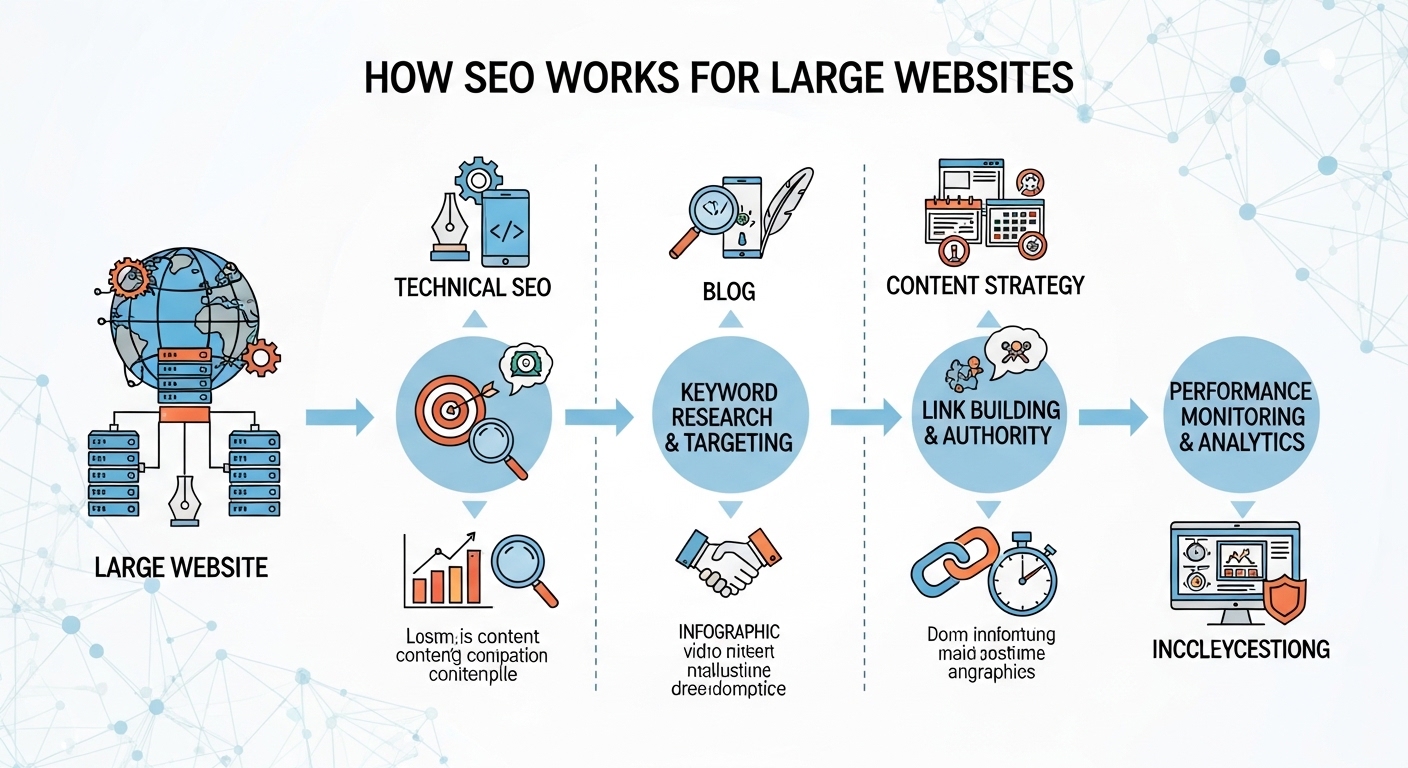
Managing a massive website is a lot like running a giant department store. In a small boutique, you can easily keep track of every shirt and pair of shoes. However, in a sprawling mall, you need clear signs, a logical layout, and a way to make sure the right customers find the right section. That is exactly how does seo work for large websites at its core. When a site grows to thousands—or even millions—of pages, the rules of the game change. You aren’t just fighting for one or two keywords anymore; you are managing a complex digital ecosystem. If you don’t have a solid plan, search engines like Google might get lost, leaving your best content buried where no one can find it.
What is SEO and how it works in the Enterprise Space
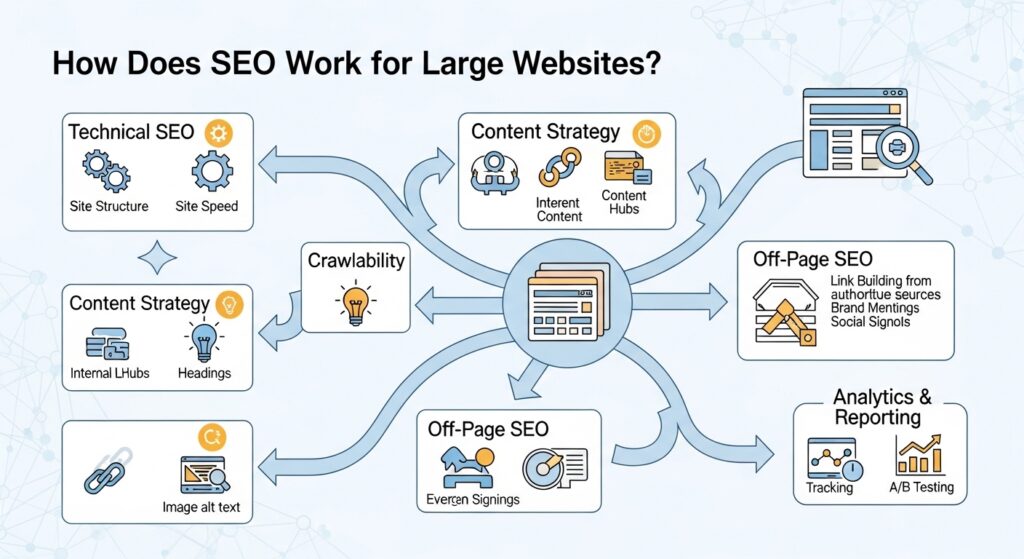
To understand the big picture, we first have to answer: what is SEO and how it works when the scale is massive? At its simplest, Search Engine Optimization is the process of making your site “readable” and “trustworthy” for algorithms. For a large site, this means ensuring that every one of your 50,000+ pages is reachable, high-quality, and relevant to a specific user search. Think of it like a conversation. If you’re talking to one person, you can whisper. If you’re addressing a stadium, you need a massive sound system. In the world of search engines, that sound system is your technical infrastructure.
What is SEO in digital marketing for Global Brands?
If you are wondering what is SEO in digital marketing for a corporation versus a local shop, the difference is all about infrastructure. While a small shop focuses on a few local keywords, a large brand focuses on programmatic SEO and total site health. It is the engine that drives organic discovery without having to pay for every single click through Meta Ads or Google Ads. When you manage a large site, you aren’t just a writer; you’re an architect. You are building pathways that allow users to find exactly what they need in seconds. This level of digital marketing strategy is what separates the market leaders from the companies that get left behind.
How does seo work for large websites examples from the Real World
Looking at how does seo work for large websites examples can make these abstract concepts feel real. Take Amazon or eBay, for instance. They don’t manually write SEO descriptions for every single one of their millions of products. Instead, they use smart systems to do the heavy lifting. These giants use Dynamic Templates to automatically generate Title Tags based on product names. They also use Smart Internal Linking to suggest “Related Items,” which helps bots crawl deeper into the site. Finally, they use Automated Schema to show prices and reviews in search results instantly. By automating the boring stuff, they stay at the top of the Search Engine Results Pages (SERPs).
On-page SEO Strategies for Massive Content Hubs
When dealing with thousands of URLs, on-page SEO becomes a game of patterns. You cannot optimize every page by hand, so you create “rules” for your Content Management System (CMS). These rules ensure that every new page you publish is already optimized the moment it goes live. You should focus on a clear Header Hierarchy, ensuring every page uses H1, H2, and H3 tags correctly to define the topic. Image Optimization is also huge; by automatically adding Alt Text to images, you tell search engines exactly what the visuals represent. Most importantly, ensure your primary keyword appears naturally in the first 100 words to give the page immediate context.
Search engine optimization techniques for Crawl Efficiency
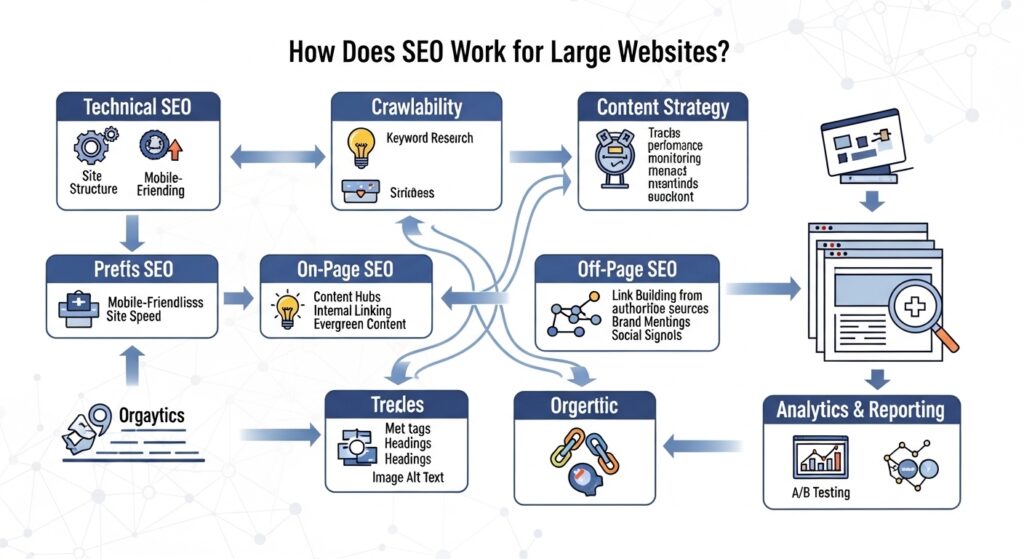
Effective search engine optimization techniques for large sites revolve around something called “Crawl Budget.” Google only spends so much time on your site during each visit. If you have “dead weight” pages, you are wasting that precious time. Start by eliminating Zombie Pages. These are pages that get zero traffic and provide no value. You should also fix redirect chains to ensure 301 Redirects go straight to the destination rather than through a series of “hops.” Lastly, manage your Faceted Navigation. If you have filters for size, color, or price, make sure they don’t create millions of duplicate URLs that confuse Googlebot.
How to do SEO for website step-by-step at Scale
If you are ready to fix your site, here is a guide on how to do SEO for website step-by-step:
- Step 1: Perform a Technical Audit. Use a professional tool like Screaming Frog to find 404 errors and duplicate content across your entire domain.
- Step 2: Fix Site Architecture. Organize your pages into “Silos.” This means grouping things logically: Categories lead to Sub-categories, which lead to Products.
- Step 3: Enhance Mobile Usability. Most of your users are on their phones. Ensure your site passes Core Web Vitals to provide a fast, smooth mobile experience.
- Step 4: Implement Schema. Use JSON-LD code to give search engines a direct data feed of your reviews, prices, and articles.
- Step 5: Monitor and Iterate. Use Google Search Console to track which sections of your site are growing and which ones need more love.
A Search engine optimization example of Success
Let’s look at a search engine optimization example involving a massive travel directory I once helped. They had 100,000 pages, but only 5% were actually showing up in Google. They were overwhelmed and didn’t know where to start. By cleaning up their Sitemap and removing 40,000 “thin” pages that had no unique content, the remaining pages saw a 400% increase in rankings almost overnight. Why? Because Google stopped wasting time on the garbage and started focusing on the gold. This is the power of a streamlined enterprise SEO strategy.
How does seo work for large websites pdf and Resources
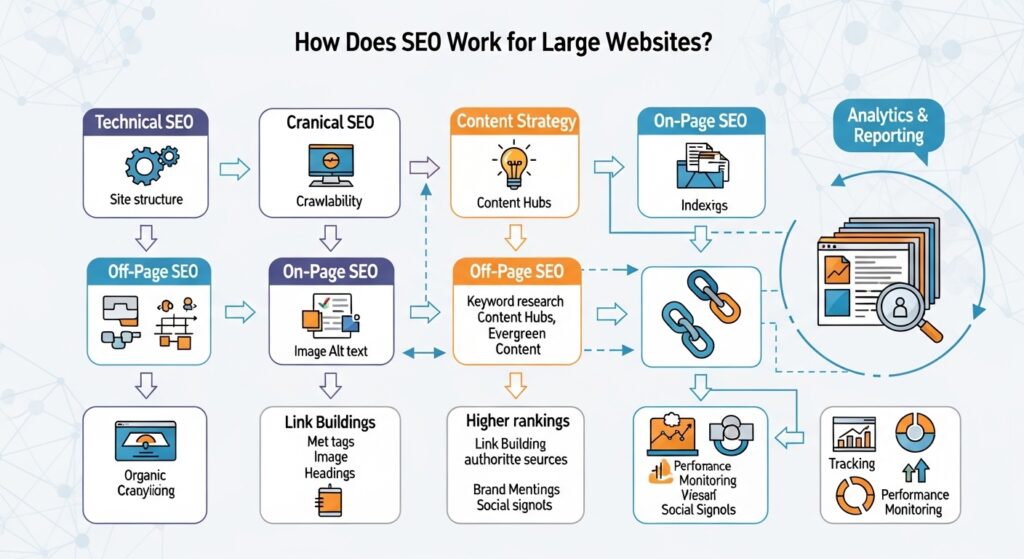
Many managers look for a how does seo work for large websites pdf to share with their development teams. While a static document can be a good starting point, SEO is a living, breathing process. Instead of a static file, we recommend using dynamic dashboards like Looker Studio. This allows you to track your site’s health in real-time. It’s much more effective to see a live map of your search performance than to look at a report that was written three months ago.
